Modern pharmaceuticals are engineered for extraordinary biological potency. They are intentionally designed to resist metabolic breakdown, survive digestive enzymes, remain stable in circulation, and exert therapeutic effects at microgram-scale concentrations.
But those same properties that make advanced therapies life-saving inside the body make them environmentally persistent once discarded. A recent study found that, as cancer diagnoses (and thus chemotherapy treatments) have increased in the general population, so has the amount of potent anti-cancer treatments being detected in water supplies.
When unused medications are thrown in household trash, flushed, or landfilled…they do not simply deactivate.
Most wastewater treatment plants are not designed to remove complex oncology agents, kinase inhibitors, or specialty antibiotics. As a result, measurable concentrations of anti-cancer drugs and other high-potency pharmaceuticals have been detected in wastewater effluent, surface water, groundwater, and even drinking water supplies.
These compounds are cytotoxic by design. Many interfere with cellular replication, DNA repair pathways, and metabolic signaling systems. In aquatic organisms, even trace levels may disrupt reproduction, immune function, and endocrine systems. Some are classified as hazardous waste in clinical settings due to their mutagenic or teratogenic properties. While they’re valuable for patients fighting cancer, they can be downright dangerous when not handled carefully. The same could be said for many other classes of drugs, as well.
The fallacy of typical disposal
Proper disposal is possible. Our pharmacy does it with medications that cannot safely be reused, such as those that have expired. Unfortunately, not all medications get proper disposal through a pharmacy or an event like a Take-Back Day.
All over the internet, including from organizations like the United States Drug Enforcement Agency and the U.S. Food and Drug Administration, patients are advised to “properly dispose” of unused medications. The problem is, sometimes those recommendations include flushing medications and/or making them unusable (by mixing with something like kitty litter) and tossing them in the trash.
The goal is to prevent misuse of some of those medications. But it leaves a lot of room for error in flushing something that can’t effectively break down in a community wastewater system or local landfill, and it may also result in the waste of usable medications!
Medication Rescue®can prevent environmental contamination by potent medications.
The contamination of community water supplies is a real concern. No household filtration system can remove these compounds. But by intercepting high-potency medications before disposal, RemediChain can not only make a positive impact both financially and for patients in need — we divert measurable toxic load from entering the environment.
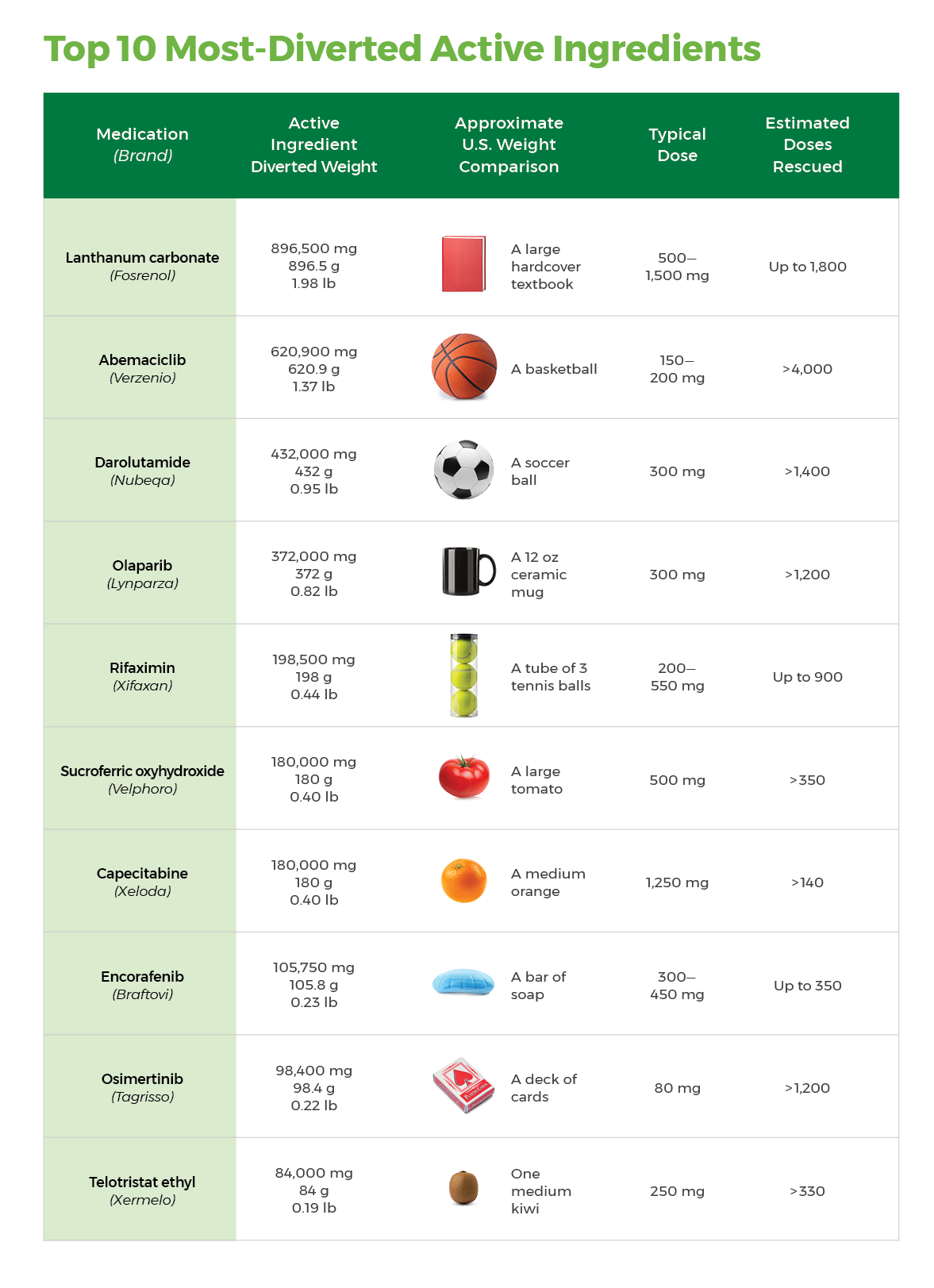
In 2025 alone, the top 10 most-diverted active ingredients represent millions of milligrams of biologically active compounds prevented from landfill and wastewater release.
To understand the magnitude, the total volume of just our ten most-rescued medications in 2025 equals approximately 3.17 kilograms — nearly 7 pounds of highly engineered, biologically active chemicals. How large an amount is that? It’s enough to provide more than 10,000 individual doses of just these medications, and it’s just a sampling of the total number.
That is roughly the weight of:
• A standard bowling ball
• A newborn infant
• A full gallon of paint
These are not inert powders. They are potent oncology and specialty agents designed to alter human cellular biology. Many are kinase inhibitors, PARP inhibitors, oral chemotherapies, and targeted oncology agents. Their environmental activity is real, not theoretical.
Here’s a breakdown of RemediChain’s top 10 most-diverted active ingredients from 2025:
Have medication to donate or need assistance accessing your necessary medications?
Medication donors can click here to access RemediChain’s medication donation form.
Patients in need of medication can click here to access RemediChain’s request medication form.