When someone learns about Medication Rescue™ for the first time, one of their first questions is often “why are these medications going unused?” For too long, this question has gone unanswered by healthcare systems in the United States. Fragmented efforts to quantify waste and understand its origins have not, thus far, painted an accurate picture of the problem.
RemediChain set out to change that. In prior years, our insight into the why was anecdotal. But in 2025, we made intentional changes to our rescue process to capture additional information that will help make medication rescue viable, safe and accessible to patients across the United States and – eventually – across the globe.
The information we tracked is statistically significant and provides in-depth analysis of trends related to medication waste. For more information beyond what is included in this report, please contact us. We’d love to support you in spreading the word or improving policy in your area.
Misconceptions About Unused Medications
There are a number of misconceptions about unused medications. Let’s dispel a few big ones here. Unused medication is NOT:
- just a problem among patients who have not adhered to their medication regimens.
- a failure of the pharmacy or pharmacist who dispensed the additional unused doses.
- insurance fraud.
Let’s quantify the above misconceptions with a “not always.” Sure, non-adherence can result in additional unused doses. Pharmacies and pharmacists, just like anyone else, do sometimes make mistakes. And fraud sometimes occurs. But these misconceptions don’t apply to the vast majority of unused medication that RemediChain rescues.
Why Medication Actually Goes Unused
Nearly half (49.8%) of all medication surplus stems from treatment modification and/or patient mortality – factors largely outside patients’ control that represent systemic opportunities for intervention and, ultimately, redirection of unused medications.
It’s important to note that our research doesn’t only cover donation-eligible medications. Donors report the “why” on all medications, even those we cannot rescue – due to expiration, open packaging, special handling requirements, status as a controlled substance or other factors.
The following numbers, while they do accurately represent the question of “why” medications were available for donation, do not add up to 100%. This is because some donors report multiple reasons a medication may be available.
The most common reasons medications go unused, as of the end of 2025, are:
- Treatment modification – 29.8%
- Patient mortality – 20%
- Adverse drug reactions – 11.7%
- Health condition resolved/improved – 9.7%
- Over-dispensing (patient received a multi-month supply) – 8.4%
- Other – 7.5%
- Non-adherence – 3.6%
- Medication errors – 1.1%
Donors who selected “other” often used the section as a catch-all for citing multiple reasons. 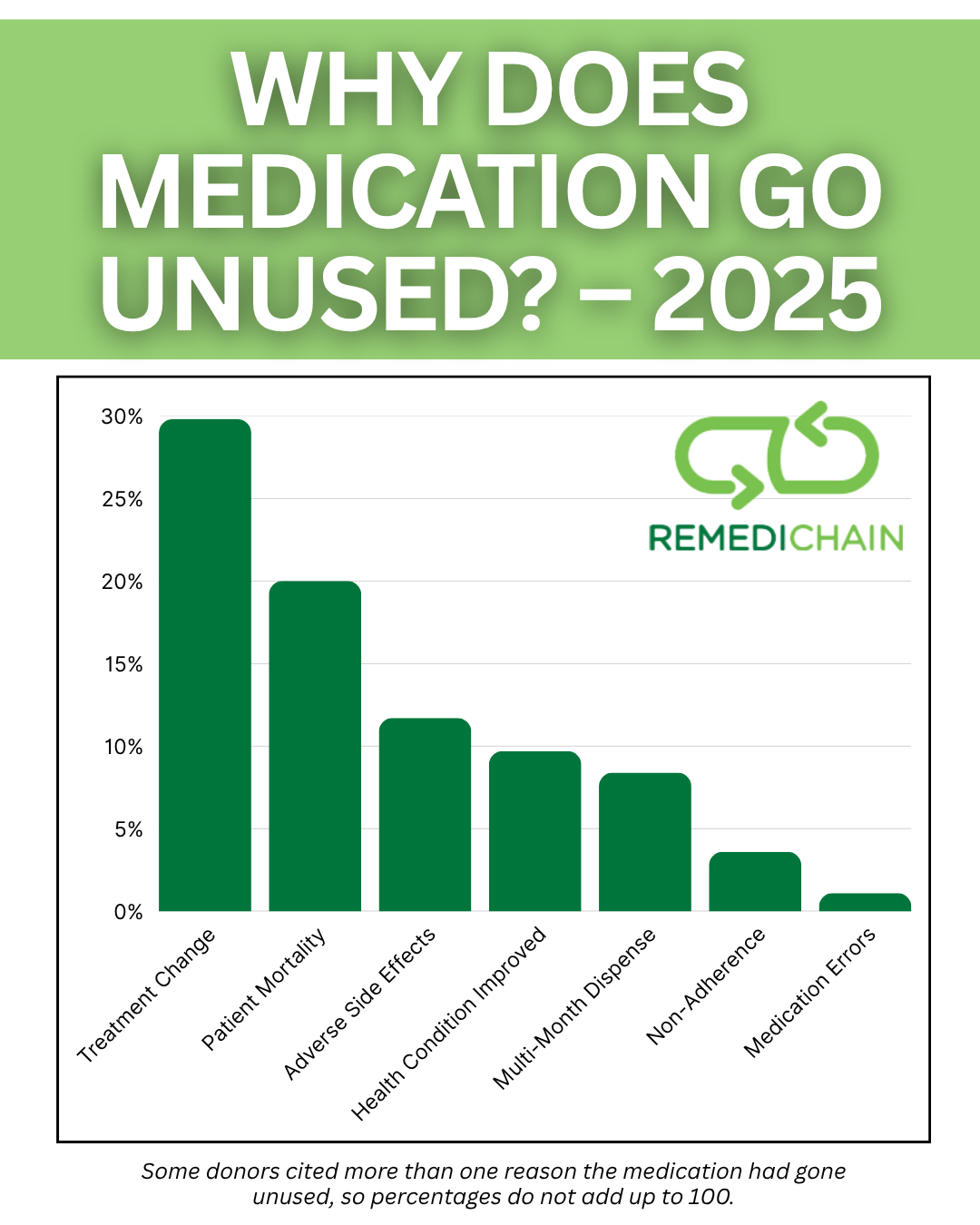
Considered as a whole, the majority of these factors are outside patients’ control. Manufacturers, providers and payers certainly could support measures that help reduce some of this waste, but that’s a topic for another post!
No matter what, the responsible, ethical thing to do when waste occurs is to rescue it to help other patients whenever possible.
Have medication to donate?
RemediChain rescues a variety of unopened, unexpired, good condition medications in accordance with Tennessee law. Donors never pay. Click here to get started.
RemediChain is a nonprofit pharmacy organization that legally and safely rescues unused, unopened, unexpired medications to share with patients in need. We’re pharmacist-owned and operated, and no patient or donor is ever charged to share or receive medication. Learn more about us here.